
Epoxy Floor Repair
Is that crack, peel, or worn patch a small fix or a sign of something bigger? Each kind of damage tends to point to a different cause, and the right response follows from figuring out which one is at work. Sometimes a few spots can be repaired on their own; sometimes the old coating has to come off entirely. A professional evaluation of the slab is how that call gets made.

The Short Answer
Think of the damage as a clue. Cracks and chips frequently come from something striking the floor or from the slab shifting underneath. Peeling or delamination means the coating has let go of the concrete — the bond itself has broken down. Dull, worn, or stained areas usually reflect traffic and chemical contact building up. Since each points somewhere different, the fix differs too, and it starts with an evaluation that pins down what failed, how widespread it is, and what shape the concrete underneath is in.
Common Problems With Epoxy Floors
What a professional repair evaluation typically encounters across the range of damage types that come up most frequently.
01
Cracks & Chips
Two distinct damage types appear most often in floor assessments. Chips and impact marks come from above — tools, equipment, or objects making contact with the floor surface. Cracks in an epoxy finish, by contrast, typically originate in the slab: settlement, shifting loads, or thermal movement that works its way upward through the coating. When damage of either type is contained, with sound coating holding its bond in the surrounding area, targeted repair may be a workable path — a determination the contractor makes after assessing the damage and its source.
02
Peeling & Delamination
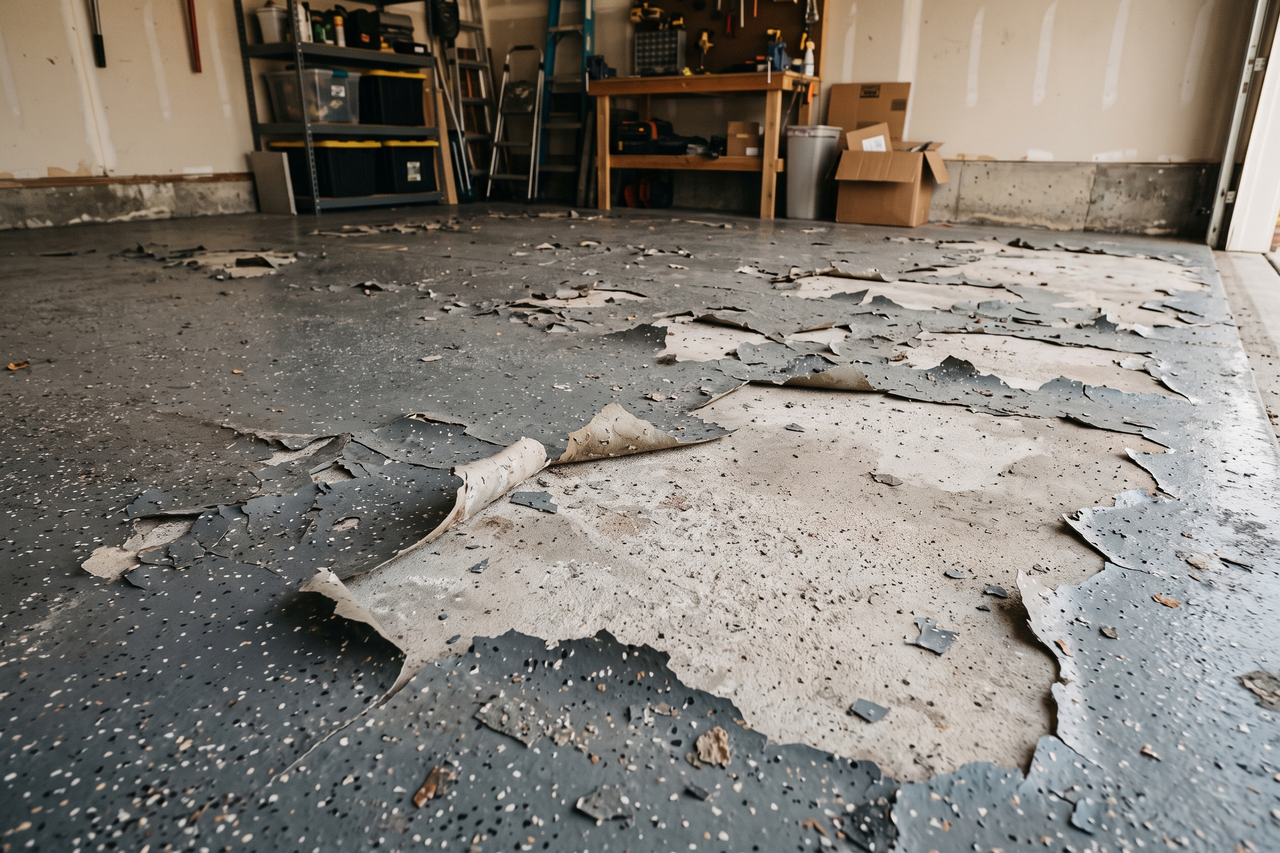
A coating that is peeling has already failed at the bond — and separation that begins in one area rarely stays confined to it. Adhesion failure in an epoxy floor usually traces back to conditions at installation: moisture that the original preparation did not account for, concrete that was not profiled to the depth the product required, or a prior coating left in place that kept the new product from reaching solid concrete. Identifying what drove the failure determines what any lasting repair needs to address.
03
Stains & Surface Wear
Not all damage is a bonding problem. A floor can look tired — dull, scuffed, or discolored by traffic and spills — while the coating underneath still holds firmly to the concrete. In that situation, a new topcoat may be enough to bring the surface back. Before going that route, the contractor checks that the bond really is intact and looks over the condition of the coating as a whole.
How Do Professionals Repair Peeling or Damaged Epoxy Floors?
It begins with a close look. Before any new product goes down, the contractor checks how much of the old coating is still firmly attached, works out why the failure happened, and inspects the concrete under the damaged spots.
Loose or lifting coating comes off; it is not painted over. If a section sounds hollow when tapped or pulls up with little effort, the bond is already gone, and layering fresh material on it just moves the weak point higher. After the failed coating is removed, the bare concrete gets cleaned and profiled so the repair material or new coating has something solid to grip.
When delamination has spread across a large share of the floor, the evaluation often shifts from spot repair toward a full recoat. The contractor assesses the complete picture before making any recommendation.
Think of the concrete prep after removal as the backbone of the repair, not a side task. Our guide to concrete preparation describes what that work includes and why it carries so much weight.
Can an Epoxy Floor Be Repaired, or Does It Need to Be Replaced?
Either can be the answer. Which one fits comes down to how much of the coating is still well bonded and what caused it to fail to begin with.
A full tear-out isn’t automatic. If the problem is confined — one patch of lifting, a cluster of chips inside a limited area, or a single crack that isn’t moving — a section-level fix is frequently possible, leaving the rest of the coating in place. Where the coating around the damage is still solid and firmly attached, a section repair may add meaningful life to the floor.
A full strip and recoat becomes the more appropriate response when adhesion failure has spread broadly across the floor, when the original installation did not address moisture conditions that remain unresolved, or when overall deterioration has progressed beyond what targeted treatment can realistically correct.
Looking at a floor can only reveal so much. When a contractor taps, probes, and tests the coating and the concrete in person, the picture of what the floor needs gets much sharper. If starting fresh turns out to be the better path, read the epoxy floor installation guide to see how a new system is put down, from initial prep to the final surface.
How Much Does Epoxy Floor Repair Cost?
Why no ballpark number here? Because “repair” can mean anything from patching one hairline crack to removing an entire coating and starting over. The total hinges on what kind of damage is present and how much of it there is, how much old coating needs removing, the state of the slab beneath, and how much prep the job calls for.
A real figure requires someone to look at the floor itself. Pricing should reflect your slab, not a generic per-foot rate.
What Causes Epoxy Floors to Fail, and How Can You Prevent It?
Knowing why coatings break down helps whether you’re dealing with a damaged floor now or planning a new one. Most early failures trace back to a handful of familiar causes.
Improper Concrete Preparation
Inadequate preparation is a recurring factor when an epoxy coating begins failing ahead of expectations. Concrete that was not ground to the required profile depth, contamination remaining on the surface, or residue from a prior coating can each prevent the new product from forming the mechanical bond it needs. A coating installed under those conditions may look acceptable at the outset, then gradually separate as the weak connection breaks down.
Treat prep as a full stage of the job in its own right. Our guide to concrete preparation breaks down what thorough preparation covers, step by step.
Excess Moisture
Moisture moving up through a slab is easy to miss and hard to outrun. Vapor that builds where coating meets concrete pushes on the bond from underneath, and the signs — bubbles, blisters, or lifting that grows — often don’t appear until some time after the job is done.
The fix has to come first: testing the slab so the contractor knows what moisture it is actually releasing. Skip that step and the product choice rests on guesswork.
Heavy Impacts and Chemical Exposure
No coating is built for everything. Hard, repeated impacts, chemicals the product wasn’t designed to handle, and constant abrasion can wear down even a well-installed floor. Picking the right system means knowing how the space will really be used; one spec does not fit every environment.
Improper Installation or Curing
Good prep sets a coating up to succeed, but mistakes during application can still undo it. Mixing components in the wrong ratio, applying outside the product’s temperature or humidity range, rushing between coats, or poor curing conditions can each lead to failure.
Ahead of the job, the installer should explain how curing will unfold and what conditions need to be kept in place. If the original failure came from an application mistake, redoing the work under controlled conditions may be the sensible fix. The epoxy floor installation guide describes a well-run installation.
Can Garage, Basement, and Commercial Epoxy Floors Be Repaired?
Garages, basements, and commercial spaces each raise different questions during a repair evaluation. What kind of damage is present and how hard the floor works every day both influence the best way forward.
Garage Floor Repair
Garage coatings take a beating from tires, hot and cold swings, spilled fluids, and dropped tools. The issues contractors see most in garages are chips, stable surface cracks, and small areas of lifting. If the damage is limited and the coating around it is still firmly attached, fixing just that area may make practical and financial sense. When chemicals have broken down large sections, or the coating is letting go across much of the slab, the conversation often moves toward stripping and recoating — something the contractor decides after reviewing the entire floor. For background, the garage floor coatings page explains what a well-installed garage coating involves.
Need to keep using part of the garage while work is underway? That depends on the size of the job and what the contractor considers practical, and it’s worth raising when you discuss the estimate.
Basement Floor Repair
Basement coating failures involve moisture conditions more often than failures in most other environments, and that pattern shapes what any repair needs to accomplish. If the original coating separated because moisture pressure was not accounted for in the initial preparation, the repair must resolve that underlying issue — not just replace the surface. Installing new coating under the same unaddressed conditions produces the same outcome.
Before recommending a repair path, the contractor looks at both how the coating is holding up and how much moisture the slab is giving off. For more background, the basement floor coatings page describes what a well-planned basement coating project involves from the start.
Commercial Epoxy Floor Repair
In a business, a failing floor is more than a cosmetic issue — it can affect safety for people moving through, cleanliness, and how the space functions day to day. If the damage is limited to one well-defined area and the coating around it is solid and firmly bonded, targeted repair may be an option. When bond loss covers more of the floor, a broader approach is often the better fit.
Can part of the facility stay open during the work? That depends on the job’s size and what the contractor considers practical, and it’s something to talk through when reviewing the estimate. The commercial epoxy flooring page describes what commercial coating work generally includes.
Frequently Asked Questions About Epoxy Floor Repair
Is a DIY patch a good idea on a peeling floor?
You can buy DIY patch kits, but if nobody figures out why the coating peeled, a patch is unlikely to hold. When the root issue is moisture, poor prep, or products that don’t get along, covering it over just sets up the same failure again. Fixing what caused the peeling is what makes the difference.
Repair or replace: how is that decided?
It mostly comes down to how far the bond loss has spread. By probing and testing the existing coating, a contractor can tell how much is still firmly attached. A small failure surrounded by solid coating can often be repaired on its own; bond loss across a large part of the floor usually leads toward stripping and recoating.
How long does an epoxy floor repair take?
The work involved reflects how much of the floor needs attention, the preparation the concrete requires, and which product system is being used. Before the project begins, the contractor outlines what the schedule looks like — including when foot traffic can return and when heavier loads or vehicles are appropriate.
Will a repaired section match the rest of the floor?
Match quality depends on the coating’s current condition, the original product used, and the extent of the repair. The contractor discusses realistic expectations based on those specifics before work begins. When appearance consistency across the entire floor is the priority, a complete recoat often produces more uniform results than patching isolated areas.
Why do epoxy floors peel — is moisture the only cause?
Moisture is a frequent contributor but not the only one. Preparation shortfalls, coating applied over an incompatible surface, errors during the application process, and insufficient curing conditions each represent independent failure paths. The contractor uses the pattern and location of the damage as a starting point for identifying the most likely origin.
Is repair work covered by a warranty?
Any warranty would come from the contractor, not from this site, and its terms would depend on the job. Ask the contractor what is covered, and under what conditions, before work starts.
Ready to Evaluate Your Floor in Russellville, AR?
Is your epoxy floor cracking, peeling, or wearing thin? Having a professional examine the slab is a sensible first step. We’ll work to connect you with an independent flooring contractor who can review the project and, if it’s a fit, prepare a customized estimate.